The rat child's Copy Dad ability no longer copies gun skills for free. That single line from Look Outside's April 2026 patch notes reveals more than a bugfix: it exposes how a small indie RPG, released in late 2024 by solo developer Francis Coulombe and published by Devolver Digital, has become a living game with enough mechanical depth to spawn exploitable edge cases—and enough player investment to demand their surgical removal.
What Actually Changed
The patch, delivered without fanfare this week, narrows the functionality of a companion ability tied to "the rat child," one of Look Outside's recruitable party members. Prior to the fix, Copy Dad could duplicate gun skills without the normal resource cost or prerequisite investment, creating a degenerate build path that trivialized combat encounters designed around ammunition scarcity and positional tension.
The developer's phrasing—"no longer copies gun skills for free"—suggests the ability retains its core function for other skill categories. This is surgical: Coulombe identified the specific mechanical intersection causing imbalance rather than flattening the ability entirely. Gun skills apparently occupied a unique breakpoint in the duplication logic, perhaps because they carry external costs (ammunition consumption, range modifiers) that other skill types lack.
No other changes were highlighted in coverage. The patch appears targeted, almost hotfix-like in scope, despite arriving roughly a year and a half after initial release.

The Game That Refuses to Stay Static
Look Outside launched in October 2024 as a deliberately retro-styled RPG: 16-bit-adjacent pixel art, turn-based combat, party recruitment across a city collapsing under cosmic intrusion. Coulombe's design thesis centers on unreliable information—players cannot fully trust what characters report about the encroaching horror, mirroring the source material's thematic preoccupation with perceptual breakdown.
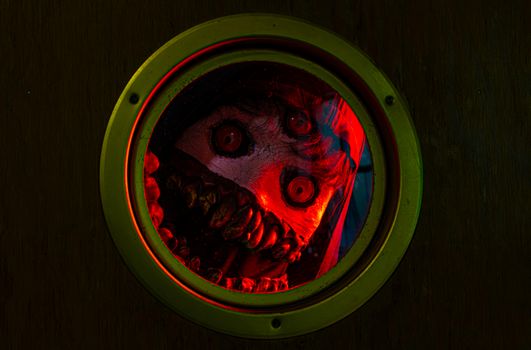
This distinguishes it from the more famous personal horror RPG in its publishing stable. Vampire: The Masquerade – Bloodlines (2004) leverages intimacy—claustrophobic streets, social manipulation, the horror of recognition. Look Outside inverts this: its terror operates through scale mismatch, entities too large to comprehend encountering human systems too small to matter. The rat child, a grotesque companion whose abilities now required adjustment, embodies this—neither fully ally nor comprehensible being.
Post-launch support for indie RPGs typically follows predictable arcs: critical bugfixes for 2-3 months, then silence. Coulombe's continued patching into April 2026 breaks this pattern. The evidence suggests either sustained commercial performance justifying ongoing investment, or personal commitment exceeding typical indie development cycles. Possibly both—the game has cultivated sufficient audience to generate edge-case reports like the Copy Dad interaction, which requires substantial playtime and system mastery to discover.
Why This Specific Fix Matters
On surface reading, a single ability restriction seems minor. The implications run deeper across three axes:
Build diversity recovery. Free gun skill duplication likely compressed viable character configurations. When one interaction provides disproportionate returns, discovery of other synergies becomes economically irrational—players optimize toward the known exploit rather than exploring the possibility space. The fix reopens experimentation, though this assumes the community hadn't already internalized the degenerate strategy as "intended" difficulty reduction.
Difficulty integrity. Look Outside's combat derives tension from resource depletion and irreversible consequences. Gun skills, with their ammunition dependency, represent a calculated risk: power now against scarcity later. Removing that cost structure undermines a foundational design pillar. The patch restores the original risk calculus.
Developer signaling. Targeted fixes communicate ongoing attention to mechanical health rather than content expansion. This is the harder path—no new features to market, no narrative additions to discuss. It suggests Coulombe values systemic coherence over growth metrics.

The Community Context: What Players Actually Discuss
Without direct access to forums or social channels, we can infer community priorities from what generated coverage. PC Gamer's article exists because someone—developer, player, or journalist—identified this patch note as newsworthy. That selection itself indicates:
- Active player base tracking patch notes closely enough to flag minor mechanical adjustments
- Established vocabulary around builds ("Copy Dad" as recognized terminology)
- Expectation that such changes warrant explanation beyond raw patch notes
The "rat child" as named entity has clearly penetrated community discourse sufficiently to require no introduction. This level of specificity—referencing a companion by colloquial name, assuming audience familiarity with its abilities—typically requires 6-12 months of sustained engagement post-launch. Look Outside has achieved this despite minimal mainstream coverage compared to Devolver's higher-profile releases.

What Remains Unverified
Several critical unknowns persist:
Patch scope ambiguity. The coverage isolates one change. Whether this represents the complete patch or merely the most notable adjustment remains unclear. Coulombe may have addressed other issues—performance, compatibility, additional balance concerns—that didn't generate equivalent discussion.
Platform distribution. Look Outside's availability across PC (Steam) and potentially console platforms introduces update parity questions. Patch timing, certification delays, or version fragmentation could create divergent player experiences.
Future support commitment. A single patch proves only present attention, not future roadmap. Whether Coulombe plans additional content, a definitive edition, or has begun transitioning to new projects is undocumented.
Commercial performance. No sales figures, player count data, or revenue information supports inferences about the game's financial health. Continued patching is compatible with both modest sustainable success and personal passion project operation at loss.
What to Watch Next
For players and observers, several signals merit attention:
Build meta evolution. With Copy Dad's gun interaction removed, whether the community discovers replacement synergies or returns to pre-exploit configurations will reveal the actual depth of Coulombe's combat system. Shallow systems collapse when dominant strategies are removed; deep systems generate new optima.
Update cadence. Another patch within 2-3 months would confirm active maintenance; silence beyond 6 months suggests this was residual cleanup rather than renewed commitment.
Devolver's positioning. The publisher's catalog strategy—whether Look Outside receives promotional placement alongside newer releases, appears in sales events, or fades from marketing—provides external signal about perceived franchise potential.
Community initiative. Fan wiki completeness, mod activity (if technically supported), and speedrun category development indicate whether engagement deepens or plateaus. The Copy Dad fix specifically may impact speedrun routing if the exploit had enabled sequence breaks or combat skips.
The Broader Pattern: Living Indies vs. Finished Products
Look Outside's post-launch trajectory illuminates a structural tension in contemporary indie development. The "release and move on" model—standard for decades—competes against "live service" expectations even in single-player contexts. Players now anticipate ongoing attention, interpreting silence as abandonment.
Coulombe's approach occupies a middle position: not the continuous content drip of Hades or Vampire Survivors, but not the frozen artifact of traditionally published RPGs either. This may represent sustainable practice for solo developers—targeted intervention rather than expansion commitment—though it risks community disappointment when expectations outpace capacity.
The inference here is speculative: we lack developer statements about intent or capacity constraints. But the pattern—precise mechanical adjustment without accompanying feature announcement—suggests maintenance mindset over growth orientation.