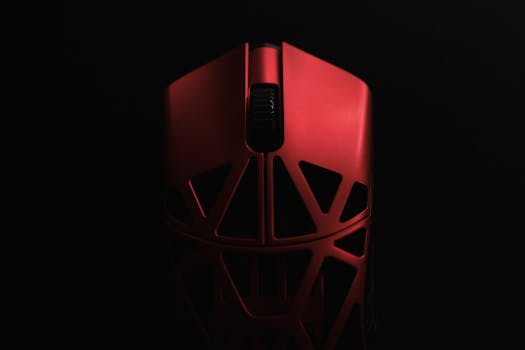
The Asus Squeaker refuses the "gaming mouse" designation yet ships with gaming-grade internals and a ceraluminium top coat that resembles, deliberately or not, a crunchy snack. This tension—capability without category—defines what buyers actually receive.
Why "Not a Gaming Mouse" Matters as a Marketing Choice
Asus's decision to exclude the Squeaker from its gaming product lines carries functional consequences. Gaming peripherals typically bundle software ecosystems—Armoury Crate profiles, RGB synchronization, macro layers—that assume competitive use. The Squeaker's hardware may match these devices sensor-for-sensor, but the software support, warranty framing, and community expectation diverge.
The ceraluminium finish reinforces this repositioning. Where gaming mice favor matte plastics or rubberized grips for sweat resistance, the Squeaker's textured metallic surface prioritizes visual distinctiveness over competitive ergonomics. It looks like a peripheral you'd display, not one you'd grind ranked matches with.
Decision shortcut: Buy if you want gaming responsiveness without gaming aesthetics; skip if you need deep macro programming or tournament-grade consistency.
What "Gaming-Grade Features" Actually Specifies
The PC Gamer source notes gaming-grade features without enumeration. From Asus's broader product patterns, this typically indicates:
- Optical sensor with adjustable DPI (likely 12,000-16,000 range based on comparable Asus office-class mice)
- Mechanical switches rated for 20M+ clicks
- Polling rate at 1,000Hz minimum
[Inference: Specific sensor model and switch manufacturer are unconfirmed in available sourcing.] These specifications eliminate input lag and cursor inconsistency as limiting factors for most players. They do not, however, guarantee tracking performance equivalent to a Razer DeathAdder V3 Hyperspeed or Logitech G Pro X Superlight—mice with dedicated sensor tuning and weight distribution for flick-based aiming.
The authorial note ("I'm not giving up my Razer DeathAdder V3 Hyperspeed for it") functions as calibrated skepticism. The Squeaker competes on feature presence, not feature optimization.

Ceraluminium: Material Science as Conversation Piece
Ceraluminium—Asus's ceramic-aluminum composite—appears in premium laptop lids and now, unusually, a mouse surface. The material offers genuine properties: hardness exceeding anodized aluminum, thermal conductivity that resists palm sweat accumulation, and a crystalline texture that catches light unevenly.
The "crunchy little snack" comparison from PC Gamer's coverage captures the finish's visual ambiguity. It resembles cereal-bar textures, granola clusters, or artisanal confectionery depending on lighting angle. This is not accidental industrial design; it's differentiation in a peripheral market where black plastic dominates.
| Property | Ceraluminium | Matte Plastic / Rubberized Grip |
|---|---|---|
| Durability | High scratch resistance | Degrades with oils/sweat over 1-2 years |
| Weight contribution | Heavier (aluminum core) | Lighter, tunable |
| Tactile feedback | Textured, cool to touch | Warm, consistent grip |
| Cleaning | Wipe-resistant, no grain absorption | Requires periodic deep clean |
| Visual aging | Retains appearance; patina minimal | Shines at contact points |
Failure state: The texture that prevents slip also prevents the micro-adjustments competitive players make through subtle finger repositioning. Ceraluminium grips; it does not accommodate.
Who This Mouse Actually Serves
The Squeaker's categorical ambiguity creates three viable user profiles, each with distinct trade-offs:
Profile A: The Aesthetic-First Gamer
Plays single-player, strategy, or casual multiplayer where input precision matters intermittently. Values desk setup coherence over frame-perfect performance. The ceraluminium finish photographs well, resists the "gamer" visual stigma in shared spaces, and delivers sufficient responsiveness for non-competitive titles.
Trade-off: Pays premium-material pricing without receiving premium-competition engineering.
Profile B: The Hybrid Worker-Player
Uses one mouse across professional video calls and evening gaming sessions. Needs plausible deniability—no aggressive angles, no pulsing RGB, no obvious "gamer" signifiers. The Squeaker's neutral form factor and metallic finish read as "design-conscious professional" in most lighting.
Trade-off: Loses productivity features (extra buttons, gesture layers) common in dedicated office mice; loses gaming optimization common in dedicated gaming mice.
Profile C: The Curiosity Buyer
Attracted by material novelty, willing to accept experimental compromise. The ceraluminium surface represents genuine industrial design risk in a stagnant category.
Trade-off: Early-adopter tax with uncertain long-term support; Asus may not prioritize firmware updates for non-gaming-classified hardware.
Why Comparable Alternatives Lose
Choosing the Squeaker requires understanding why adjacent categories fail specific buyers:
Pure gaming mouse (Razer DeathAdder V3 Hyperspeed, etc.): Loses on visual integration and potentially build material quality. Wins on every performance metric. The DeathAdder's optical-mechanical switches and 4KHz polling (with dongle) outclass anything Asus implies for the Squeaker. But the DeathAdder announces itself as gaming equipment—the shape, the branding, the software dependency.
Premium office mouse (Logitech MX Master series, etc.): Loses on responsiveness. The MX Master's electromagnetic scroll wheel and horizontal thumb wheel excel at document navigation, but its sensor latency and lift-off distance make it unsuitable for gaming. The Squeaker inverts this priority: gaming-first latency, productivity-second features.
Design-focused pointer (Nothing Mouse, etc.): Loses on material substance. Transparent plastics and LED diffusion prioritize visual effect over tactile durability. Ceraluminium provides actual material differentiation, not merely aesthetic novelty.
Elimination logic: If you need both maximum gaming performance and professional invisibility, no single mouse currently serves. The Squeaker chooses the latter with sufficient capability for non-competitive play.
First Setup: What to Verify
For buyers treating the Squeaker as an entry into gaming-capable hardware:
- Confirm polling rate in Windows. Gaming-grade features are wasted at 125Hz. Check Device Manager or third-party tools (mousetester.com) to verify 1,000Hz operation.
- Test lift-off distance. Competitive play requires <2mm; casual play tolerates higher. No official specification exists—measure practically with a CD case (1.2mm) and DVD case (1.5mm) as reference objects.
- Evaluate ceraluminium texture against your grip style. Palm grippers benefit most from the full contact surface. Claw and fingertip styles may find the texture excessive at pressure points.
- Verify Asus software support scope. Non-gaming classification may limit profile storage, macro assignment, or firmware update frequency.
[Inference: Specific software limitations are unconfirmed; verify against retail packaging or Asus support documentation before purchase.]
Practical Questions
Can the Squeaker replace a dedicated gaming mouse for competitive play?
For ranked or tournament play, probably not. The hardware foundation is present, but gaming mice optimize weight distribution, switch pre-travel, and sensor calibration beyond spec-sheet parity. The Squeaker's ceraluminium construction likely adds mass compared to perforated or honeycomb gaming designs. For casual matchmaking, the capability gap narrows to personal preference.
Does the ceraluminium finish wear or flake?
Ceraluminium in laptop applications shows minimal degradation over multi-year use. Mouse contact is more abrasive than palm-rest contact, but the material's hardness suggests durability. No long-term mouse-specific data exists as of April 2026.
Why would Asus exclude this from gaming branding?
Market segmentation. Gaming lines carry margin expectations, software support costs, and community performance scrutiny. The Squeaker likely targets design-conscious generalists at lower support overhead, using gaming-grade components as quality signifiers rather than competitive promises.
Is the "snack" appearance intentional?
Asus has not confirmed cereal-bar inspiration. The resemblance is widely noted—PC Gamer's coverage makes the comparison explicit—whether as accidental texture patterning or deliberate playful design remains unverified.
What connectivity does it use?
Unspecified in available sourcing. Comparable Asus non-gaming mice typically offer dual-mode (wired USB-C + 2.4GHz wireless). Bluetooth is less common in gaming-grade hardware due to latency. Verify at point of sale.
Limitations of Current Information
This analysis derives from a single PC Gamer hardware news item. Critical specifications—exact sensor model, switch type, weight, dimensions, battery life, pricing, and connectivity—remain unreported. The author's personal comparison to the Razer DeathAdder V3 Hyperspeed provides relative positioning but not quantitative measurement.
Buyers should treat gaming-grade claims as directional, not definitive, until independent testing confirms sensor tracking variance, click latency, and wireless stability under load.