Solitaire: What Actually Changes Your Win Rate (It's Not Luck)
Most players think Solitaire is 70% luck, 30% skill. The real split is closer to 50/50 once you stop treating every face-down card as equally valuable. Your first three moves in a Klondike hand create cascading constraints that determine whether you'll stall in the mid-game or have options at turn 20. This guide covers the decision patterns that separate consistent winners from players who blame the shuffle.
The Tutorial Lied: Draw-1 vs. Draw-3 Is a Different Game
The Google Play app you're using offers both modes, and most beginners pick Draw-1 because it feels forgiving. It is—for about ten minutes. Then the boredom sets in.
Draw-1 exposes every card in the stock pile on each pass. Sounds like more information, which should help. But it also means you see every card you can't play yet, which creates false urgency. You start making moves to "do something" instead of building proper sequences. The game becomes a slog where you win by attrition, not planning.
Draw-3 forces harder choices with partial information. You see three cards, play the top one if possible, and the others bury deeper. This creates a genuine resource-management problem: do you play that red 6 now, or hold it to potentially free a black 7 underneath? The answer depends on what you've already committed to the foundation piles.
Here's the asymmetry most guides miss: Draw-3 rewards patience more than Draw-1 does, but punishes hesitation more severely. In Draw-1, waiting costs nothing—you'll see that card again in two minutes. In Draw-3, a card buried under two others might not surface for three full passes, by which time your tableau could be frozen.
| Situation | Draw-1 Response | Draw-3 Response |
|---|---|---|
| Only playable card blocks a buried card you need | Play it anyway; you'll see the buried card soon | Consider holding; the buried card may not resurface in time |
| Empty tableau column available | Fill it cautiously; easy to recover | Fill it aggressively; empty columns are rarer to create |
| Foundation buildable but breaks tableau sequence | Usually safe to build | Often better to delay; tableau flexibility matters more |
The app offers "all winning deals" as an option. Use this for training, not for ego. Play ten winning deals in Draw-3, track which moves felt forced versus optional, and you'll start recognizing the structural patterns that repeat across random shuffles.
The First Hour: Build These Habits or Rebuild Them Later
Your initial sessions should focus on three skills that feel unnatural but become automatic:
Expose face-down cards before playing to foundations. Every face-down card is a locked door. The card on top of it might be useless, or it might be the only 8 you need to move that 9 of opposite color. A common early mistake: building Ace→2→3 to the foundation immediately because it's "progress." But if that 2 was covering a face-down card in the tableau, you've delayed your information gain for zero benefit. Build to foundations only when the card isn't needed below, or when the tableau card it frees is already exposed.
Color balance in tableau columns. Klondike runs on alternating colors. If your tableau has three black-heavy columns and one red-heavy column, you've created a traffic jam. Black cards can only stack on red, so excess black cards compete for the same landing spots. Early in a hand, before you know the full distribution, spread your builds across both colors evenly. This is invisible in the moment but determines whether you have "a place to put things" ten moves later.
The empty column is not a parking space. New players treat an empty tableau column as storage. It's not. It's a converter—the only way to move a King from one column to another, which can expose the card beneath it. Once you park a random King there, that column is dead until you can clear the King, which requires building a full sequence down to 2. That's a massive commitment. Only empty a column when you have a specific King waiting to move, or when you're certain the column's original cards are fully extracted.
The app gives unlimited undos and hints. Use undos as a learning tool, not a crutch. When you lose, rewind ten moves and ask: what was the first move that closed a door I later needed open? That's your real feedback.
Currency and Modes: What Actually Costs You
This app is free with ads. No energy systems, no gem purchases, no pay-to-skip. The only currency is your attention span, and the game modes are where you spend it poorly.
Timed vs. Untimed. Timed mode scores higher but trains bad habits. You start clicking the stock pile rapidly, playing the first available move, missing deeper sequences. If your goal is win rate, play Untimed. If your goal is leaderboard position, learn to play fast correctly first—speed without pattern recognition just buries you faster.
Vegas scoring vs. standard. Vegas scoring penalizes each stock pass and rewards foundation builds. This flips the optimal strategy: in standard scoring, you might delay foundation builds for tableau flexibility; in Vegas, the point loss from extra passes often outweighs that flexibility. The app offers "Vegas cumulative" which tracks across sessions. Don't touch this until you can consistently win standard games. Cumulative Vegas is a bankroll management problem, and starting it with unformed habits is like learning poker in a cash game instead of play money.
Daily Challenge. These are curated deals, not random. The solution path exists and is discoverable. They're excellent for learning specific techniques—how to unwedge a buried card, when to sacrifice a foundation build—but don't assume random deals behave the same. Daily Challenges often have tighter constraints that force creative moves; random deals are messier and more forgiving of mediocre play.
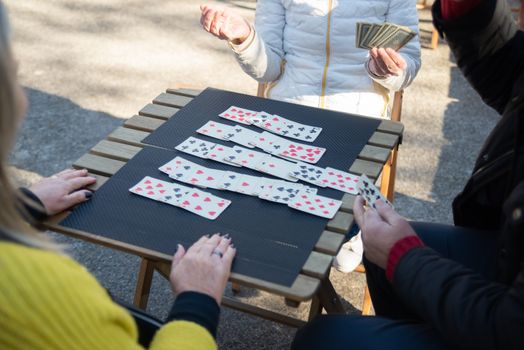
Your Next Three Decisions Shape Everything
You're five moves into a hand. Here's what to actually evaluate:
Decision 1: Which face-down card to expose first? Pick the column with the most face-down cards that you have a plausible path to clearing. A column with four face-down cards and a 10 on top is worse than a column with two face-down cards and a 5 on top, because you need a 6,7,8,9 sequence to reach those four cards. The shorter stack is more accessible.
Decision 2: Play to foundation or build in tableau? The heuristic: if playing to foundation would leave a tableau card stranded with no legal move, delay. The exception is when the foundation card is covering a face-down card—then the information gain usually wins.
Decision 3: Use the empty column now or wait? Wait, unless you have a King that immediately enables exposing a face-down card, or unless holding the empty column is blocking multiple other moves. The empty column's value increases as the game progresses and sequences get longer; spending it early is like cashing a retirement account at 25.
What to Do Differently Tomorrow
Stop restarting hands that look "bad" after the deal. Most Klondike losses happen at move 15, not move 1. The shuffle determines your ceiling; your decisions determine whether you hit it. Play the ugly hands to completion, note where they broke, and you'll start seeing that the "bad" hands often had a narrow path you missed because you were already mentally in the next game.