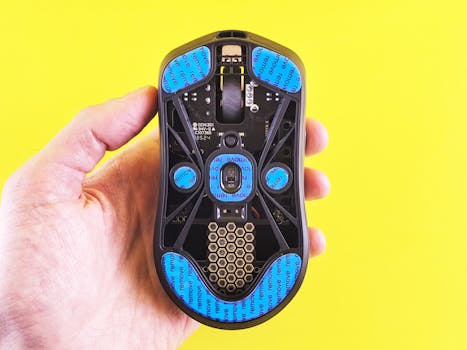
The Pulsar Xlite 500g began as an April Fools' joke that became real hardware—half a kilogram of gaming mouse that, per PC Gamer's hands-on testing, moves "extremely sluggish" visually but performs "really not that bad" in practice. For newcomers, the gap between expectation and reality is where most damage happens: wrist strain from fighting the weight, or abandoned purchases from premature dismissal. This guide maps your first hours to protect both.
First-Hour Priorities: Don't Treat This Like a Normal Mouse
Standard lightweight mouse advice inverts here. Where typical guides preach faster, lighter, more aggressive movements, the 500g demands you slow down before you speed up.
Priority 1: Validate Your Physical Baseline
Pick up the mouse. Rest your forearm flat on your pad. Move it six inches left, six inches right. If your shoulder engages before your elbow, or your wrist bends past 15 degrees laterally, stop. The 500g amplifies every biomechanical compromise that a 60g mouse forgives.
Self-check: Can you perform ten slow lateral sweeps without grip adjustment? If your pinky or thumb repositions, your grip lacks the surface contact area this weight requires. Fix this before any game loads.
Priority 2: Establish a Reference Sensitivity Anchor
Do not convert your existing eDPI directly. The 500g's momentum carries through stopping distance differently—PC Gamer's testing noted the visual sluggishness that results from mass resisting direction changes. Instead, find your physical comfort limit first:
- Open any aim trainer or FPS practice range
- Set sensitivity to approximately 60% of your current value
- Track a slow-moving target for 30 seconds
- Increase by 10% until micro-adjustments require finger motion, not wrist
- Lock that value for 48 hours minimum
This feels wrong to experienced players. That's the point. Your muscle memory was trained on different physics.
Core Mechanics: How Mass Changes the Input Loop
Every mouse interaction has three phases: acquisition, tracking, and commitment. The 500g stretches each in ways that punish certain habits and reward others.
Acquisition: The Lift Problem
Lightweight mice reset position with minimal effort. The 500g requires deliberate lift mechanics or you drag across the pad. Two solutions:
Palm-dominant users: Increase lift-off distance in software to 2-3mm. The sensor will ignore the slight drag that occurs when you lack finger strength to clear the pad entirely.
Claw or fingertip users: You face a harder choice. The 500g's weight pulls fingers toward extension, flattening claw into palm over long sessions. Either transition your grip proactively or accept shorter play blocks with stretch breaks every 20 minutes.
Tracking: Momentum as Feature
Here's the non-obvious axis: the 500g's mass stabilizes against micro-tremor. PC Gamer's "really not that bad" assessment likely stems from this—once moving, the mouse holds a vector more consistently than featherweight competitors. The failure state isn't missing shots; it's overshooting because you expect to stop faster than physics allows.
Decision shortcut: Favor tracking-heavy weapons or roles. The 500g punishes flick-heavy playstyles (Widowmaker, AWP, Marshal) where rapid direction changes dominate. It rewards sustained tracking (Zarya beam, SMG tracking, LMG sustained fire) where momentum becomes predictability.
Commitment: When You Can't Abort
With light mice, you can freeze a movement mid-flick. The 500g commits you. This changes target selection: pre-aim corners more conservatively, swing wider than you think necessary, and accept that peeker's advantage diminishes when your crosshair takes longer to settle.
Build and Settings: What Actually Matters
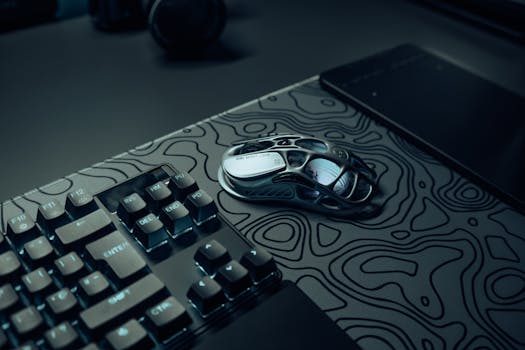
The 500g ships as a fixed product—no weight adjustment, no modular shells. Your "build" is environmental and digital.
Mousepad: Friction Budget
High-friction cloth pads compound the problem. You need controlled glide without fighting static friction. Medium-fast hybrid surfaces (Cordura, certain glass-infused cloths) reduce initial breakaway force while maintaining stopping power. The 500g's mass provides natural damping; don't add more through pad choice.
Skip if: You own a mud pad (heavy control, slow glide). The combination exhausts forearm muscles within an hour.
Sensor Polling and Motion Sync
Standard 1000Hz polling is fine. The 500g won't benefit from 4000Hz or 8000Hz—the limiting factor is human biomechanics, not sensor latency. Turn motion sync ON if available; the slight input delay (1-2ms) smooths the visual disconnect between hand movement and on-screen response that PC Gamer described as "extremely sluggish."
DPI: Lower Than You Think
| Hand Size | Recommended Starting DPI | Typical In-Game Sensitivity Range |
|---|---|---|
| Small (<17cm) | 400-600 | 1.5-2.5 @ 400 DPI equivalent |
| Medium (17-19.5cm) | 400-800 | 1.2-2.0 @ 400 DPI equivalent |
| Large (>19.5cm) | 400-800 | 1.0-1.8 @ 400 DPI equivalent |
These are lower than equivalent lightweight recommendations because arm aiming becomes mandatory. Finger aiming exhausts quickly at 500g.
Beginner Mistakes: The Failure Modes
Mistake 1: The Grip Death Spiral
New users clamp harder as fatigue sets in, compressing tendons and accelerating cramp. The correct response to slipping is grip widening—more contact area, less pressure. If you find yourself squeezing, pause. The mouse won't fly away; it weighs half a kilogram.
Mistake 2: Sensitivity Panic
After a bad round, the temptation is to crank sensitivity to compensate for perceived slowness. This destroys the stability advantage the weight provides. Accept that your TTK (time to kill) in flick scenarios will suffer. Don't sabotage your tracking consistency to chase impossible flicks.
Mistake 3: Session Length Hubris
Even if you lift weights, the 500g uses stabilizer muscles differently than gym work. The brachioradialis and extensor carpi group fatigue from sustained low-load isometric holding, not peak contraction. Your first sessions should not exceed 45 minutes. Build duration across two weeks, not two days.
Mistake 4: Dismissing It Too Early
PC Gamer's testing suggests adaptation occurs—"really not that bad" implies expectation adjustment, not mere tolerance. Most users quit in hours 2-4 when novelty fatigue peaks. Commit to ten hours before judging competitive viability.
Decision Archaeology: Why Alternatives Lose for Different Players
The 500g isn't universally wrong, but it's wrong for specific profiles. Here's why plausible alternatives fail different users:
Lightweight mouse (60-80g): Wins for reaction-time dominant players, loses for anyone with essential tremor or who plays in caffeine-heavy states. The 500g's mass filters out hand noise that lighter mice transmit directly to cursor.
Ergonomic vertical mouse: Wins for established RSI cases, loses for gaming performance. Vertical grips sacrifice precision for joint alignment; the 500g maintains gaming-grade sensor positioning while forcing posture change through weight instead of shape.
Trackball: Wins for desk space constraints, loses for any game requiring rapid repositioning. The 500g preserves the fundamental mouse paradigm; trackballs break it.
Standard mid-weight (90-110g): The compromise position. Wins for indecision, loses for distinct advantage. The 500g commits to a property; mid-weight mice commit to none.
Best for: Players with larger hands, existing arm-aiming habits, tracking-preferring game roles, or those treating the purchase as deliberate constraint training.
Skip if: You primarily flick-shot, have active wrist or forearm injuries, play at very low sensitivities requiring large pad sweeps, or value portability between setups.
Progression Path: Your First Ten Hours
| Hour Block | Focus | Success Metric |
|---|---|---|
| 0-1 | Grip validation, sensitivity anchor | 10-minute continuous hold without repositioning |
| 1-3 | Tracking scenarios only | 70% accuracy on slow strafing targets |
| 3-6 | Introduce click-timing (not full flicking) | No worse than 15% performance drop vs. previous mouse |
| 6-10 | Full game integration, role selection | Identified "this works" and "this doesn't" weapon/role pairs |
After hour 10, decide: commit to the 500g as primary, reserve for specific games/roles, or retire. The sunk cost is real but smaller than chronic strain from forced adaptation.
Next Steps and Maintenance
If continuing: replace mouse feet every 3-4 months (the 500g accelerates wear through pressure), maintain consistent pad cleaning schedule, and monitor for grip migration—your hand will try to revert to old habits under stress.
If retiring: the 500g retains value as a deliberate practice tool. Twenty minutes of tracking drills before switching to your competitive mouse can stabilize fundamentals. The weight exaggerates errors; correct there, perform lighter.
The Pulsar Xlite 500g is not a better mouse. It is a specific mouse with specific physics that, per PC Gamer's April 2026 testing, functions beyond its joke origins. Your job is not to overcome it but to map yourself to its constraints—and recognize when that mapping costs more than it yields.